KeraSpace

KeraSpace

Classrooms that listen to orbit

Flight-heritage GNSS and ground-station kits that turn academic labs into live satellite stations — then into a global telemetry mesh.

The problem

A trillion-dollar industry taught on blackboards

The global space economy is accelerating toward $1 trillion, yet aerospace universities and high schools still teach satellite communications on either €25,000 legacy parabolic hardware — or theory alone.

Europe and international space agencies face a severe shortage of engineers with practical RF, GNSS, and satellite telecommunications skills. CubeSat operators, meanwhile, struggle with sparse, expensive ground coverage for basic housekeeping downlinks.

From Greek κεραία — antenna

Flight-heritage hardware under €200

KeraSpace builds modular, flight-grade kits and an integrated cloud learning platform. Institutions track, decode, and operate live satellites from a classroom window — with curriculum already validated through International Space University teaching.

Dual product architecture

Two kits. One pathway into orbit.

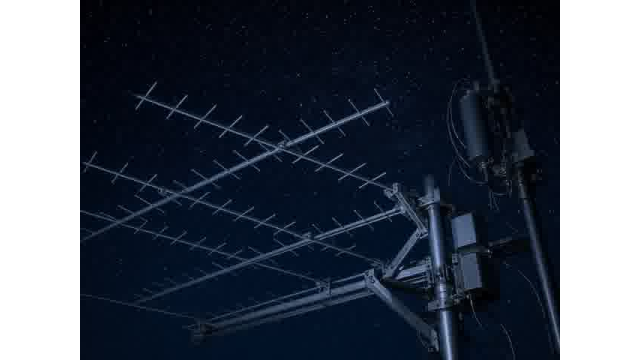
Modular ground-station antenna array under a starfield

VHF / UHF · classroom ground station

01

GNSS Navigator Kit

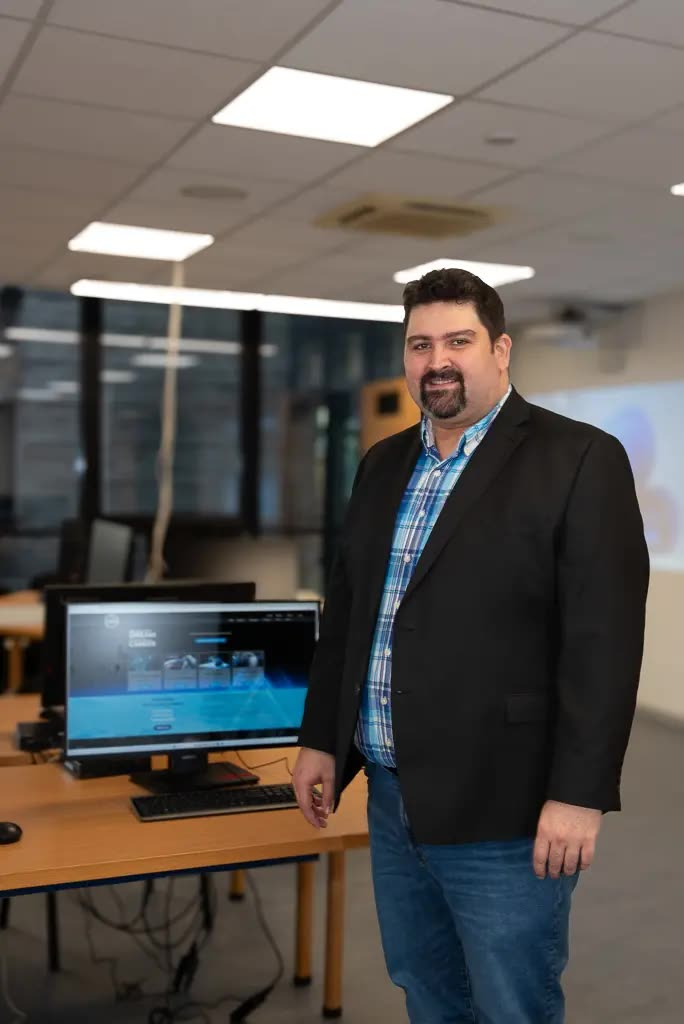
Led by Dr. Anwar

Multi-constellation u-blox receiver, active ceramic patch antenna, and a 10-week laboratory course covering trilateration, NMEA parsing, and planetary geodesy — already taught at ISU.

  • GPS, Galileo, GLONASS, BeiDou
  • PPS status LEDs + precision leveling tools
  • Turn-key labs for physics, GIS, and surveying departments

Retail

€149 – €199
02

Orbital Ground Station Kit

Led by Dr. Ramson

Snap-together chassis, wideband RF receiver, and modular antenna rods for live weather-satellite decoding, ISS SSTV reception, and CubeSat Doppler tracking — built from flight-heritage practice.

  • NOAA / Meteor image decoding
  • CubeSat Doppler curve fitting
  • Designed for STEM clubs and university CubeSat teams

Retail

€129 – €499

Trojan Horse engine

Hardware distributes. Data compounds.

Every kit is a node. Sell the station, connect the classroom, aggregate the passes — then sell low-latency housekeeping telemetry back to constellation operators.

Phase 1

Education hardware

High-margin GNSS and ground station kits sold to schools and universities — the distribution vehicle for everything that follows.

Phase 2

KeraCloud SaaS

Institutional subscriptions for student lab accounts, live classroom telemetry dashboards, and automated grading.

Phase 3

The Orbit Mesh

Connected classroom stations form a decentralized listening network — crowdsourced TT&C for commercial CubeSat operators.

Founding team

Flight heritage meets curriculum design

Academic credentials spanning ISU, UT Austin, and UF Gainesville — with flight-heritage engineering and curriculum already proven in MSS workshops. KeraSpace ops run toward Station F, not an ISU campus host.

Dr. Moulay Anwar Sounny-Slitine

Dr. Moulay Anwar Sounny-Slitine

Co-Founder & CEO

  • Assistant Professor of Space Applications, ISU
  • Research Fellow, UT Austin
  • Associate Professor, UF Gainesville

Leads product strategy, curriculum design, and commercial operations. Teaches satellite geodesy, GIS, and remote sensing across ISU, UW–Madison, and Texas State. Designed the ISU GNSS Workshop that anchors KeraSpace’s educational product line.

Dr. Ramson Nyamukondiwa

Dr. Ramson Nyamukondiwa

Co-Founder & CTO

  • Assistant Professor of Space Engineering, ISU

Ph.D. Kyutech. Four orbital missions — ZIMSAT-1, ZIMSAT-2, BIRDS-5, LEOPARD. Low-cost SDR ground stations. FCC Extra Class KI5KZS.

Next step

Building European space sovereignty from Station F

KeraSpace is entering Station F Landing Zone in Paris — proximity to CNES, Thales, ESA BIC, and French Tech deeptech networks — to ship the first university kit pilots and launch KeraCloud.